

How Abigail Spanberger Bested Trump
His speech was built on crisis and spectacle. Hers assumed American democracy still works.

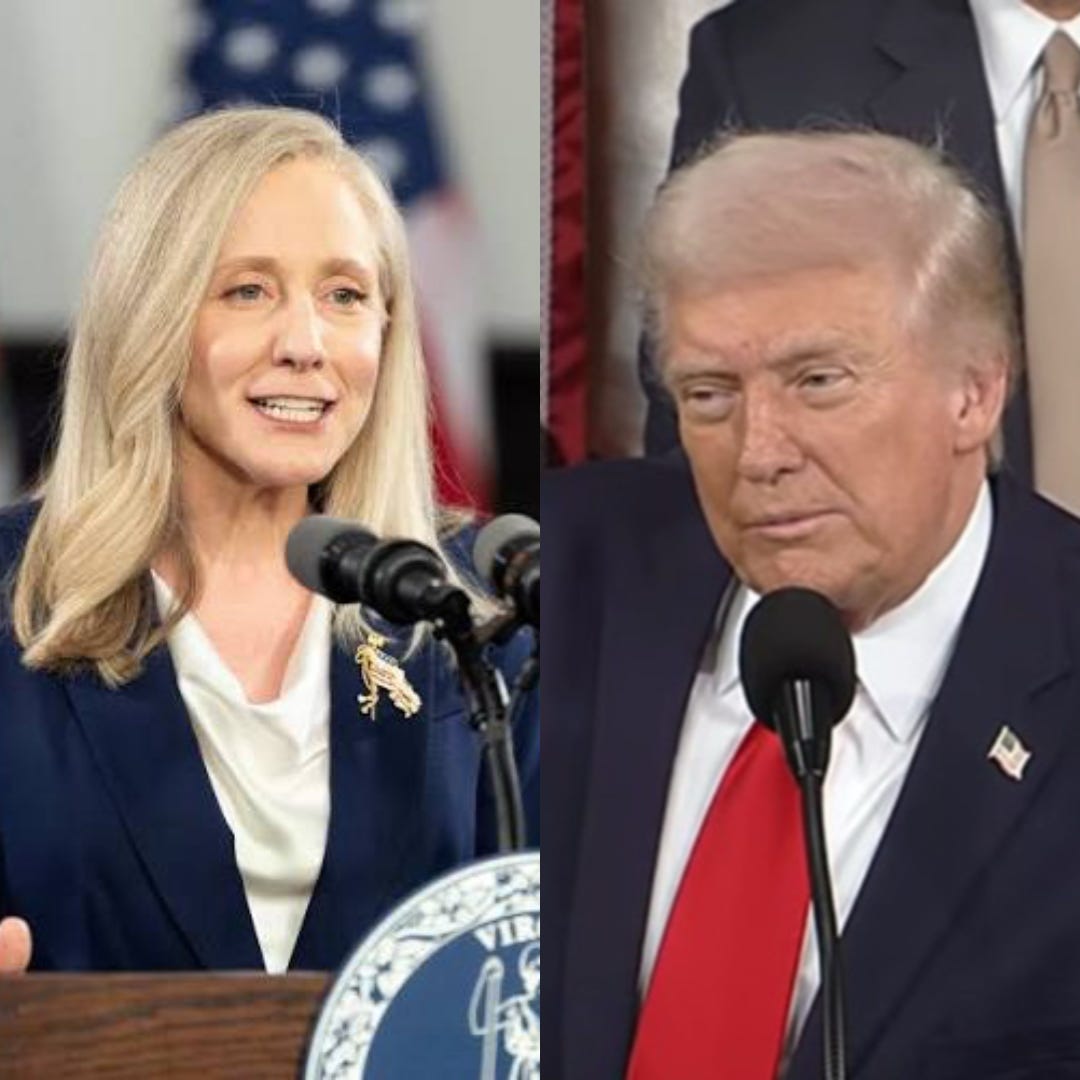
On Tuesday night, Americans were offered two visions of national leadership. The contrast was fascinating and crucial. This election year, our country stands at a crossroads of democracy, and in their starkly different speeches to the American people this week, President Trump and Virginia Governor Abigail Spanberger clarified the choice before us.
This isn’t merely partisan. It’s deeper than that; we’re past that. American political parties have always offered different plans and proposals for national success, and they have waged fierce electoral battles to turn those plans into policy and law. This time, we’re fighting about something far more fundamental.
Two visions of America
When Donald Trump says he wants to “Make America Great Again,” he is not simply offering a reactionary slogan. He is proposing a different idea of America altogether.
The nation Trump described from the Rostrum in the House Chamber on Tuesday night is alien to the mainstream of our history. He spoke of our country not as a republic built on shared, revolutionary ideas, and the practice of those ideas by all kinds of people from all kinds of places across two-and-a-half centuries of democratic self-governance, but rather as an embattled, even failing, society under siege—rooted in a mythic past, suspicious of change, and defined more by some people’s specific inheritance than by all our people’s common aspirations.
Trump was proclaiming (and performing) the enthnonationalism that has taken hold of the Republican Party. You know—all that humbug and guff about “Heritage Americans;” and that “We’ll have our home again” white supremacist slogan that ICE uses to recruit agents now; and J.D. Vance’s weirdo declaration that “people whose ancestors fought in the Civil War have a hell of a lot more claim over America” (even if they fought to destroy the United States) than the roughly 150 million living Americans who do not have dead relatives who did anything like that. And so much more.
The politics of loss
It’s a surrender to fear. They’re afraid—of tomorrow. They do not grasp that the true strength of our country lies in the courage of our openness and the power of those old, self-evident truths we hold. All these blood-and-soil neo-nationalists think they are restoring American Greatness. They think this racial rubbish makes them look strong—truer and bluer Americans than anyone else.
But I hear pessimism and weakness in it. Donald Trump does not believe in the power of our ideas. He understands power only as dominance. And Trump has lost faith in our Founding. For him, faith is for suckers and ideas are bullshit. Millions of Americans have converted to this faithlessness, and settled for his shrunken America.
In the House chamber this week, beneath President Trump’s showy and stage-managed triumphalism, the actual content of his speech felt pessimistic, insecure, and small.
The power of normalcy
Governor Abigail Spanberger answered Trump in a very interesting way. She did not engage, as I just did, on some grand plane of Vancian debate about the meaning of America. And that was a good choice.
Because that debate is…weird.
And the best-kept secret in politics today is that most Americans are still normal.
They don’t want some apocalyptic mythos about how the national soul is being threatened by nannies from El Salvador or roofers from Mexico.
They don’t want ferocious online armageddons deciding the future of our country.
They don’t want wars. They don’t want tariffs. They don’t want a king.
What most Americans want from politics is what most Americans have always wanted: Pragmatic solutions to the problems they face. Government policies and actions that will improve their lives and their communities. And they are very, very smart about all that.
Spandberger understands that. Her speech was a calm and effective attack on Trump from the ground of normalcy. It contained few specific policy proposals; her goal was simply to show that Trump doesn’t get it. That he is making things worse. That he is wrong about the answers to the problems in our country.
American confidence
She spoke plainly. And she spoke from the assumption that democratic self-government still works—that problems are solvable through deliberation, compromise, and competence. And that Trump and his administration lack all of that.
She reminded Americans that politics is about delivering. And delivering is about focus, solutions, and execution. And that takes hard work—for the people.
“Let me ask you three questions,” she said. “Is the President working to make life more affordable for you and your family? Is the President working to keep Americans safe — both at home and abroad? Is the President working for YOU?”
It was a brisk and structured attack, and it landed. Trump has some of the worst polling numbers of his political career right now for good reasons. And Spanberger made clear why: It’s all about him. Not about you.
The real choice
Underlying it all was her quiet insistence—in her words and in her delivery—that ordinary, boring self-government can still work. She sounded calm because she clearly believes that our future can be made better, that the American experiment still works. Trump sounded urgent because his politics depends on persuading people that it no longer does.
And in the end, that is how Abigail Spanberger bested Donald Trump.
Well said. And she did it in less than 20 minutes.
Class act versus clown act. Reductive, maybe, but in many ways, I think it's just that simple. What I wonder, though, is how many if any of the MAGA set dared to tune into Governor Spanberger's address, and if so, what was their reaction to it.
Because the contrast between those two addresses could not have been more stark.