

God and Caesar
Donald Trump has picked a fight with the Pope. What it reveals about both men.

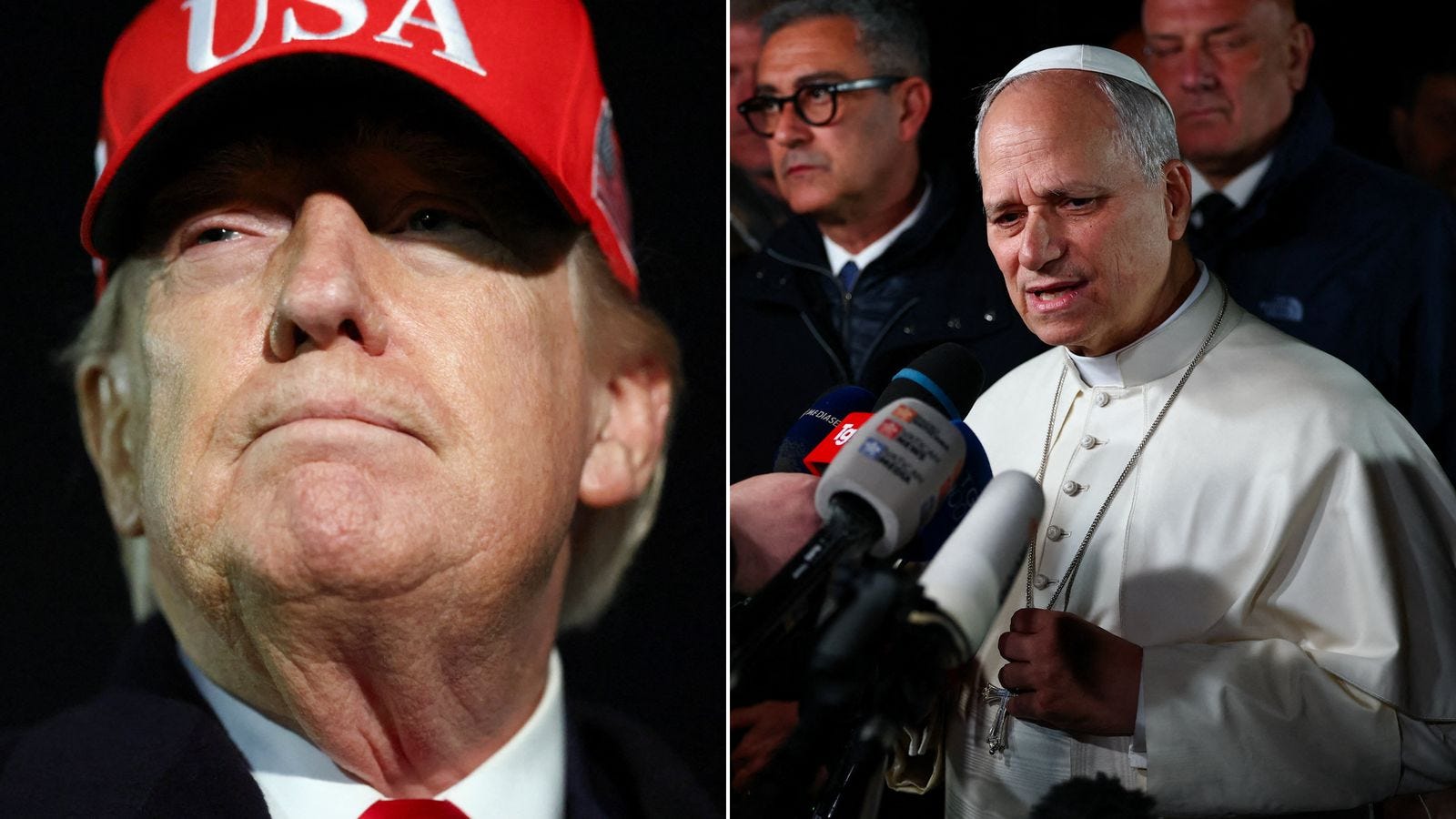
On Easter Sunday, Pope Leo XIV stood before tens of thousands of the faithful in St. Peter’s Square and called on humanity to “abandon every desire for conflict, domination and power.”
He was speaking to the world. But he was also speaking, unmistakably, to one man.
That man heard him.
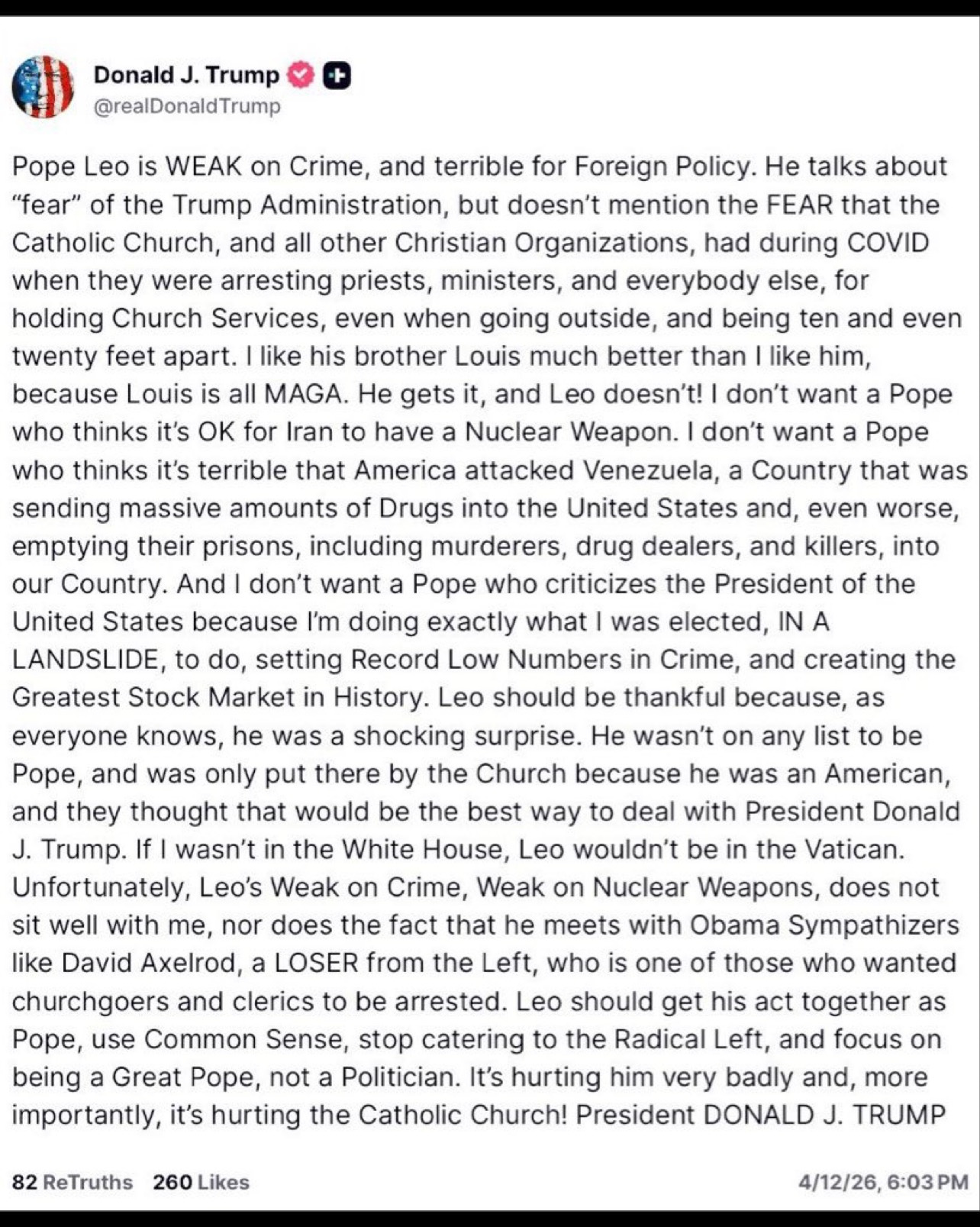
Last night, President Donald Trump was on social media with a shocking attack, calling the Pope “WEAK on Crime, and terrible for Foreign Policy.” Trump suggested, with his characteristic neediness and self-absorption, that Leo owed him his papacy. He said he preferred the Pope’s brother Louis—”because Louis is all MAGA.”
And then, as if to clarify the theological stakes here, Trump posted an AI-generated image of himself in biblical robes, surrounded by eagles and an American flag, laying hands on a bedridden man as divine light emanated from his fingertips.
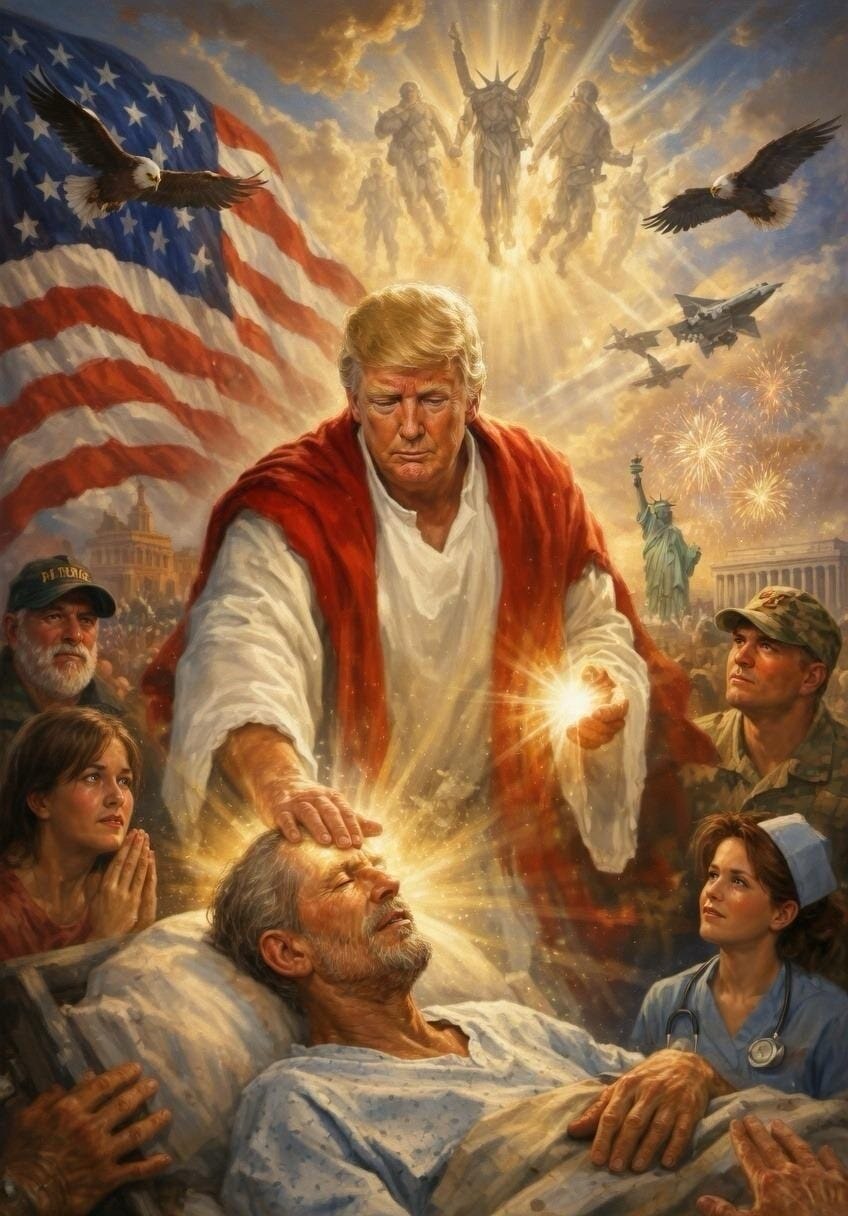
I mean—I guess the Second Coming was just a first draft?
Seriously—that image is a disgrace. And it is an attack, on both the American presidency under our Constitution, and on the faith of millions. But most of MAGA loves it.
No single weekend in recent memory has crystallized the central moral confrontation of our political moment more sharply. On one side: a man who came from genuinely humble beginnings—Chicago, the Midwest, and then decades serving humbly in a religious order, most of that time as a missionary in Peru—and who now, from the Chair of St. Peter, insists that the Gospel means what it says: “Blessed are the peacemakers.”
On the other: a man who came from a rich family in New York City, built a tower with his name on it in gold, and has spent a lifetime insisting that he alone is the measure of all things.
These are not merely policy differences. They are two entirely different conceptions of the human person—and of power itself.
Leo has been careful not to name Trump directly. He doesn’t need to. When the pope warns against the “delusion of omnipotence” fueling wars of choice, when he says that Jesus “does not listen to the prayers of those who wage war, but rejects them,” when he calls Trump’s threats to annihilate Iranian civilization “truly unacceptable”—he is doing what authentic spiritual and moral leaders have always done: naming the sin without excusing the sinner. He is following a tradition that runs from St. Ambrose confronting the Roman Emperor Theodosius, to St. Thomas More facing Henry VIII, to Archbishop St. Oscar Romero of El Salvador preaching against the country’s death squads right up to the moment they killed him—at the altar.
President Trump’s response is equally clarifying. He accused the Pope of being soft on crime. He said Leo “likes crime, I guess.” (This is part of Trump’s rhetorical efforts to get Americans to believe that the vast majority of immigrants are violent criminals, when the truth of course is the opposite.) He called the pope “a very liberal person.” He suggested the Catholic Church had cynically engineered Leo’s election simply to manage Trump himself—a claim typical of a man who has a pathological need to be at the center of any major news story, event or social-media trending meme in the world.
But there’s a logic to the president’s lashing out at the pope.
Trump has spent his political career routing his opponents by finding their pressure points and applying maximum force. He has attacked veterans, judges, prosecutors, the press, and the families of fallen soldiers. Everyone, eventually, has bent or broken or been destroyed. The Pope, however, is not running for anything. He cannot be primaried or indicted or fired. He answers to a different constituency—one that doesn’t show up in polling averages. He answers to a different Master than poll ratings.
And that, precisely, is why Trump fears him.
The one thing Trump’s political project cannot survive is a credible, courageous, non-partisan call to basic human decency. Partisans can be mocked. Critics can be dismissed as enemies. But a soft-spoken priest from Chicago who asks only that the words of Jesus be taken seriously—that is a harder enemy to fight.
You cannot call him a RINO. You cannot say he’s part of the deep state. You can only say, as Trump has now said, that you don’t like him. But here’s the trap: In saying so, you reveal everything.
American Catholics gave Trump 55 percent of their votes in 2024. They are watching this fight. So are the bishops, who have broken, carefully but unmistakably, with the president who has claimed God’s endorsement for a war that the American Congress never authorized.
In Hungary, Viktor Orbán—Trump’s most devoted European acolyte, the man who built the playbook Trump has been running—was just defeated after a decade in power. The people were exhausted. The populist circus—the cruelty, the corruption, the constant enemies, the promises never kept—had finally worn them out.
Something similar may be stirring here. People are tired of the performance. They are tired of the fight. They are tired of a politics that offers nothing but dominance and contempt. They, perhaps, would prefer pragmatic results in bringing down the cost of living and restoring the promise of American upward mobility.
The Pope is not a politician. The pope must not be a politician. Pope Leo has said so himself, and he’s right.
But Trump has changed politics. His politics forces a moral choice on each of us. When politics has become this nakedly immoral—when it has swallowed up the language of faith itself, weaponized it, turned prayers into war cries—then the Gospel itself becomes, whether anyone likes it or not, a political act.
Donald Trump has made it so.
And somewhere over Africa, on a plane headed to Algeria, the first American pope is not afraid.
—Terry
Pope Leo is a true man of God, and I admire him deeply. Trump is losing his mind.
Bravo to Pope Leo! You make us proud Chicagoans!